


Repotting a Moss-Pole Plant into a Self-Watering Pot
TL;DR
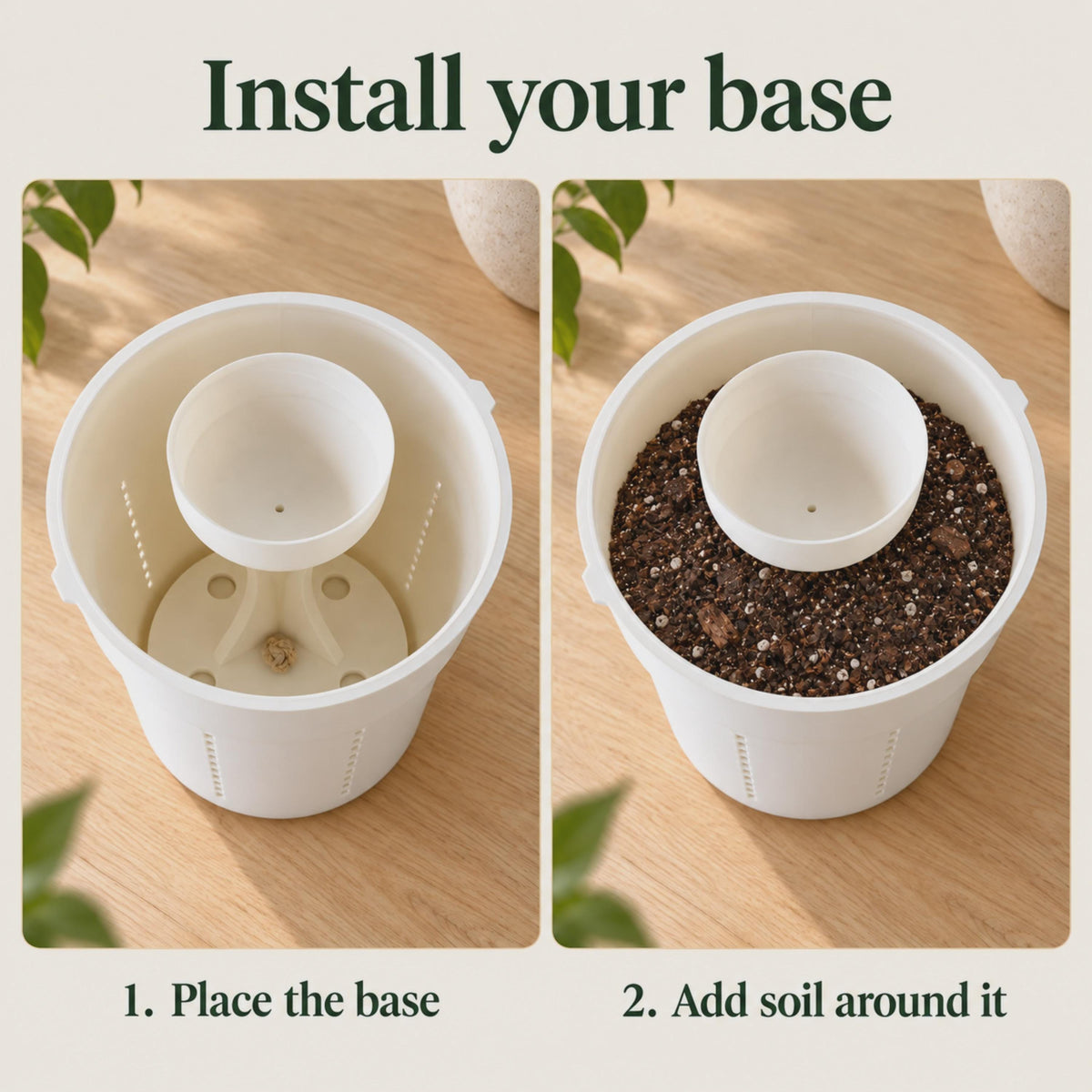
Plan space for both the roots and the pole anchor, support the plant throughout the move, and test the assembled watering system. Keep healthy roots attached to the pole where possible. This guide covers moving into a wick-watered pot while retaining a suitable potting mix. Changing to PON or LECA at the same time adds a separate root-cleaning and aftercare job.
Before you start
Gather the assembled new planter, compatible wick, pre-moistened potting mix, soft ties, clean scissors and a tray. Ask someone to hold a tall plant, or support it securely while you work. A moss pole is much less entertaining when it lands on your laptop.
- Check whether repotting is needed: roots crowding the insert, repeated toppling or a deteriorating medium are useful reasons. One root at a drainage hole is not an automatic emergency.
- Check root health: firm roots can be brown or stained. Soft roots that collapse or shed their outer layer need attention before a larger pot.
- Check the water route: does the pole drain into the pot? That water will count towards the new setup's watering too.
Climbing Philodendron can root into growing medium and attach to supports. [1] If roots already grip the pole, treat the plant and pole as one connected unit.
Choose the insert
Measure the root ball and pole anchor together, then check the usable internal dimensions. The decorative outer diameter alone can be misleading. Leave enough room to settle the medium around the roots without crushing them, but avoid a large ring of unused wet mix. Excess medium relative to roots can remain wet longer. [2]
Want a heavier base without a much larger root space? Look for a stable compatible outer planter while keeping the insert appropriately sized. Check that it preserves the intended reservoir and drainage arrangement.
My modular moss pole has a base intended for my signature pots from 12 cm (4.7 in) upwards. [4] Check compatibility before ordering rather than assuming any pole fits any insert.
Move it together
- Empty the reservoir or saucer first. Work on a surface that can catch loose mix and runoff.
- Support the main stem and pole. Release the old pot by gently squeezing its sides or sliding the root ball free. Never lift the plant by a leaf stalk.
- Keep sound attachments. Do not peel established roots away from the pole just to make the plant easier to handle. Remove loose old mix without combing every healthy root bare.
- Place the wick according to the pot design. Make contact with the lower medium and the intended water source. A wick dangling through air cannot supply a disconnected root zone.
- Set the plant at its previous planting depth. Position the anchor securely, add medium around the roots and settle it gently. Keep the growing point clear.
- Retie the main stem loosely if needed. Leave unfolding leaves free and space for stem thickening.
Roots threaded through the old pot? Free them carefully. Cutting an inexpensive plastic nursery pot may be kinder than tearing a valuable root network out of its holes. Protect hands and roots while cutting.
Test both water paths
Water the medium evenly and follow the planter's filling instructions. Wick irrigation depends on capillary movement, the wick and contact with the growing medium. [3] Check that moisture actually reaches the roots rather than simply admiring a full reservoir.
For my signature pot, water from above and stop before the reservoir reaches the coloured section. [5] For another design, use its own fill guidance.
Next, test the pole with a small controlled addition. Watch where runoff ends up. If it enters the planter, check the reservoir before adding more. If the pot is already wet but upper moss is dry, moisten the dry section carefully rather than repeatedly flushing the entire pole.
Aftercare and problems
- First few days: keep the previous suitable light and warmth. Check plant firmness, pole stability and moisture instead of refilling automatically.
- Dry mix above a full reservoir: inspect wick placement and medium contact; supply root-zone moisture while fixing the connection.
- Wilting with wet mix: check the waterline and roots. More water is not the first response.
- Leaning after watering: support the stem and review the anchor and base. Do not wedge the plant upright by tightly packing the medium.
Changing to mineral substrate? Use the soil-to-PON guide for the separate transition and monitoring steps.
Common myths
- “All roots must be scrubbed clean for any self-watering pot.” A wick-watered potting mix is not the same job as changing substrates. Preserve healthy roots when staying with a compatible mix.
- “A pole waters the pot for me.” Observe runoff. It may add water, but it does not measure what the pot already contains.
- “A much bigger pot fixes a leaning climber.” Check support and anchoring first; root space and stability are different decisions.
FAQ
Must I remove the moss pole?
Usually not if it fits the new setup and remains sound. Keeping established attachments can make the move gentler. Replace it when compatibility, condition or access makes that necessary.
Should I fill the reservoir immediately?
Follow the planter and medium instructions, check initial moisture and monitor uptake. There is no universal waiting period that applies to every wick setup and root condition.
Can I repot a very tall plant alone?
If you cannot keep the plant and pole supported while releasing the pot, arrange help. Emptying water and preparing everything beforehand reduces the time the root ball is unsupported.
Ask a question
Tell us your plant, current root-ball size, medium and pole type. Are the roots attached to the pole, and does pole water enter the planter? Include the new insert's usable diameter so we can help plan the move.

 Monstera and Philodendron Aerial Roots: Guide, Leave or Trim?
 Self-Watering Moss Poles: Setup, Refills and Troubleshooting
 Choosing and Securing a Moss Pole for Climbing Plants
Comments