


Choosing and Securing a Moss Pole for Climbing Plants
TL;DR
Choose a support you can anchor securely and maintain easily. A trellis supports stems; a moss-filled pole can also provide a moist surface for attaching roots. Modular poles add height conveniently, but the foundation, connections and plant weight still determine stability.
Choose your support
Start by identifying the growth habit. Some Philodendron climb, while others form a self-supporting clump and need space more than a tall pole. [1] Monstera and other climbing plants can benefit from upright support.
- Trellis or stake: useful if you mainly want to guide stems and reduce sprawling. No moss-watering routine to maintain.
- Coir-wrapped support: a textured structural option. Check its core, anchor and extension method; do not assume it retains moisture like loose sphagnum.
- Moss-filled pole: useful when you want roots to contact a surface you can keep appropriately moist. Choose a design with accessible watering and secure anchoring.
- Modular design: adds sections without replacing the entire support. Inspect how those sections join and whether the base can support the proposed height.
Already struggling to water the plants on time? A straightforward trellis may suit you better than another moisture routine. Choose the support you will actually maintain.
Make the base stable
- Check the planter footprint. A tall leafy plant on a narrow lightweight base can tip even when the pole itself is strong.
- Inspect the anchor. Seat it to the intended depth and follow the support's assembly instructions. An extension balanced on top of another section is not a connection.
- Plan around the root ball. Installing a support during a necessary repot is easier than stabbing an anchor through established roots. If adding it later, locate space carefully.
- Assemble joints straight. Clean debris from the mating surfaces and engage threaded connections correctly. Avoid forcing a crooked thread.
- Test gently before letting go. Support the plant, apply light sideways pressure and check the base and joints. Correct movement at its source.
Do this with the planter in its normal position. A setup stable against a wall may behave differently when pulled forward for watering.
Tie the right part
Guide the main climbing stem towards the support with a soft adjustable tie. A leaf stalk, or petiole, connects one leaf to the stem; leave it room to move. Keep the growing tip and emerging leaf free.
Place ties where they support the stem without crushing it. Check them during maintenance and loosen them as the stem thickens. Direct flexible aerial-root tips towards the support gently. A rigid old root does not need to be bent into obedience.
For choosing whether to guide or trim stray roots, see the aerial-root guide.
Add height sensibly
Add an extension when the growing stem is approaching the available support, while you can still reach and assemble it comfortably. Hold the lower structure during installation and recheck the base afterwards.
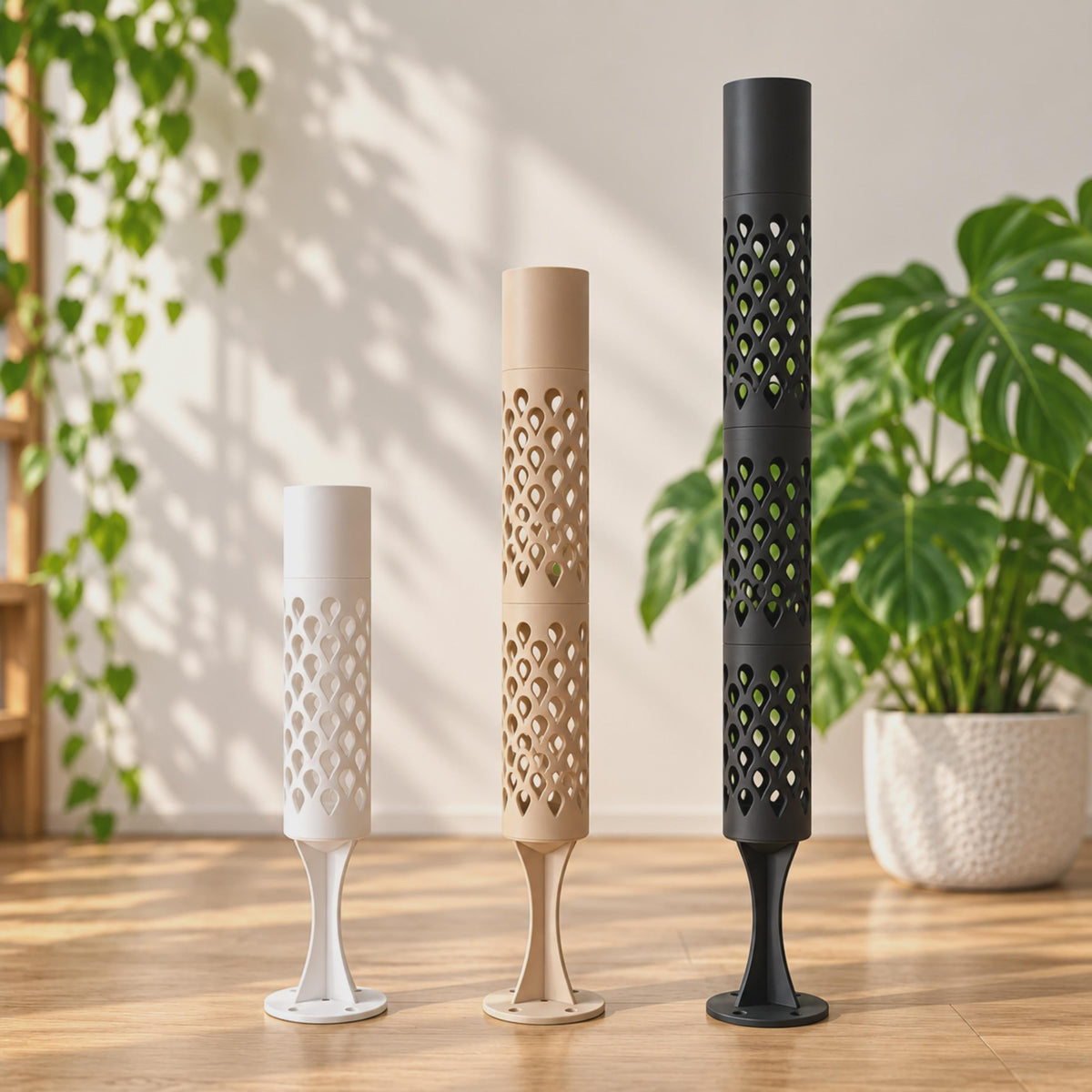
My modular moss pole uses threaded sections and a top drip cup. One extension adds approximately 20 cm (7.9 in); the listed configurations are approximately 48 cm (18.9 in) and 68 cm (26.8 in). Its base is designed for my signature pots from 12 cm (4.7 in) upwards. [2]
Longer is not automatically better. Recheck the assembled height, plant weight, access to the top cup and stability before extending further. Reachable watering matters more than a support that nearly touches the ceiling.
Fix common problems
- Whole setup tilts: support the plant and check the base footprint, anchor and uneven pot placement.
- Only an upper section moves: inspect that connection for debris, incomplete engagement or damage.
- Plant pulls away from the pole: reposition a loose stem tie and guide new growth. Do not yank established roots.
- Moss is dry but the pot is wet: adjust the watering route. Read the moss-pole watering guide before flooding the pot again.
Common myths
- “A modular pole can be extended indefinitely.” Every assembled support needs a suitable foundation and manageable load. Evaluate the actual configuration.
- “A moss pole guarantees huge mature leaves.” Support is one part of care. Light, roots, nutrition, species and time influence growth too.
- “Tie every leaf upright.” Support the climbing stem while allowing leaf stalks and new growth to move.
FAQ
Is moss essential for climbing?
No. A trellis or another suitable structural support can guide a climber. Choose moss when you also want to maintain a root-contact surface.
Can I move a plant already attached to a pole?
Keep the connected plant and pole together where practical. Support both during the move and avoid pulling attached roots free just for convenience.
Should I use a pole for every Philodendron?
No. Identify whether yours climbs or forms a self-supporting clump, then choose support or space accordingly.
Ask a question
What plant, pot size and support height are you working with? Does the whole planter lean, or only one joint? A photo of the base and connections makes the problem easier to pinpoint.

 Monstera and Philodendron Aerial Roots: Guide, Leave or Trim?
 Repotting a Moss-Pole Plant into a Self-Watering Pot
 Self-Watering Moss Poles: Setup, Refills and Troubleshooting
Comments