


Alocasia Corm Troubleshooting: Mould, Soft Spots and Slow Growth
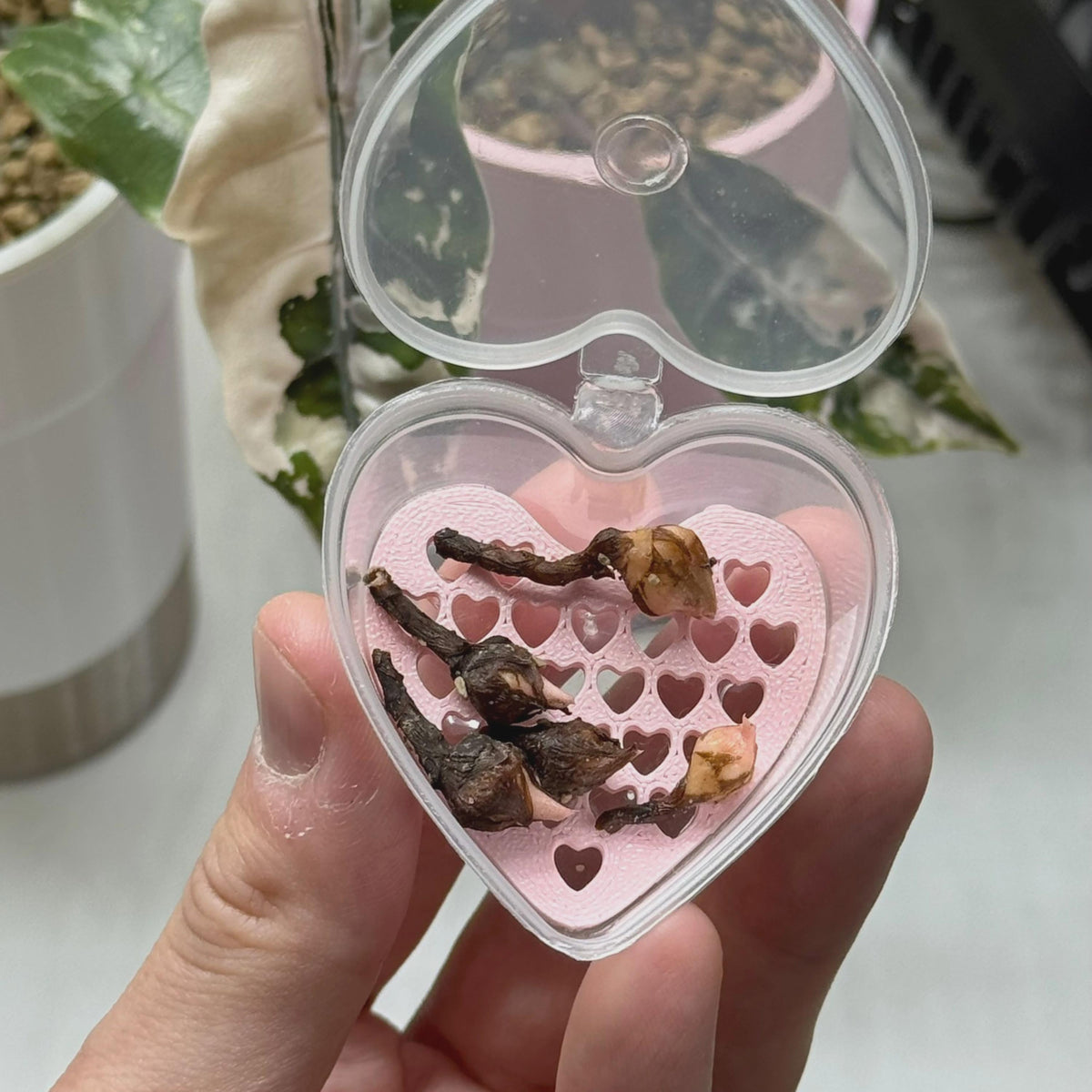
TL;DR
A slow Alocasia corm is not necessarily a failed corm. Start by checking whether it is firm, whether decay is spreading and whether the setup is appropriately moist and warm.
Surface mould, a soft base and a firm corm that has not sprouted need different responses. Isolate a deteriorating corm, clean its container and correct the growing conditions. Avoid repeated peeling, cutting or chemical treatments simply to make something happen.
Step by step
1. Separate the problem from the rest of your collection
If a corm is softening or developing suspicious growth, move its container away from healthy propagations. Do not share its water or reuse dirty tools between cups.
Take a clear photo before making changes. This gives you something useful to compare with a few days later and helps if you need advice from the seller.
2. Inspect gently
If necessary, lift the corm carefully and rinse away loose debris with clean water. Check its texture without squeezing hard or repeatedly disturbing emerging roots.
Look for the difference between a firm corm with a loose outer sheath and tissue that is becoming wet, soft or collapsing. Colour alone is not a reliable diagnosis. White material around developing roots can also be difficult to identify from appearance alone.
3. If there is surface mould, check the conditions
Remove loose decaying material and clean the cup. If the medium is contaminated or has broken down, replace it with fresh, suitable medium.
Check for excessive moisture and increase ventilation thoughtfully. A humid enclosure can support propagation, but it still needs monitoring.
Mould on the outer surface does not prove that the entire corm is rotten. Equally, rinsing it does not guarantee that an underlying problem has gone away.
4. If the corm is soft, assess whether recovery is realistic
A corm that is collapsing throughout, smells unpleasant and has no identifiable healthy growth point is unlikely to recover. Discard it and clean the equipment before using it again.
Localised damage is harder to assess. Some firm tissue remaining does not guarantee survival. For a valuable corm, contact the supplier with photos before removing tissue around its growth point.
Routine scraping followed by kitchen cinnamon is not a dependable treatment. Cutting creates a wound, and the original cause still needs addressing.
5. If it is firm but slow, review the setup
Check temperature near the container rather than relying only on the room thermostat. Provide appropriate warmth and gentle light, and keep the medium from becoming either saturated or completely dry.
Check orientation with the supplier if you are unsure which end should face upward. Do not bury an emerging shoot deeply.
Keep conditions stable and record changes. Moving a corm between moss, water and mineral media every few days creates disturbance without telling you which approach is helping.
6. Support new roots with minimal handling
Once roots appear, let them develop. Use a small starting container that is easy to inspect and adjust your moisture management as the plant grows.
A riser can help hold a corm in place, while a humidity cup provides a sheltered growing space. Neither removes the need to check water contact, moisture and cleanliness.
Follow the corm-growing journey to choose a starting setup and move into a larger pot when your plant needs it.
FAQ
Is six weeks without a leaf too long?
A fixed number of weeks does not establish whether a corm is viable. Its firmness, growth point and signs of developing roots are more informative.
Should I peel every corm?
Avoid forcing away attached tissue. Removing a loose papery sheath is different from peeling into the living corm. Ask your supplier if its condition is unclear.
Should I spray it with 3% hydrogen peroxide?
This guide does not recommend routine full-strength spraying. Do not assume a household peroxide treatment is suitable for every corm or emerging root.
Is algae a sign of rot?
Algae and rot are different. Algae can indicate light reaching a damp surface; check cleanliness, water quality and the corm's condition rather than diagnosing rot from green colour alone.
Will extra heat make it sprout immediately?
No. Appropriate warmth may help a cool setup, but it cannot restore dead tissue or guarantee a rapid response.
Sources
- Royal Horticultural Society: How to grow alocasias. General growing conditions and propagation guidance.
- Penn State Extension: Pest and Disease Problems of Indoor Plants. General guidance on plant problems, including root decay.
- University of Minnesota: Managing insects on indoor plants. Explains how watering and drainage can contribute to growing problems.
These sources support the growing principles above. They do not establish a guaranteed treatment for an individual Alocasia corm.
 The Puddle Method for Alocasia Corms: Rooting Without Rot
 How to Do the Puddle Method for Alocasia Corms
Comments