


Fungus Gnats in Houseplants: How to Break the Cycle

TL;DR
Catch the adults, but target the larvae in the pots. Remove fallen leaves, correct unnecessarily wet conditions and use yellow sticky traps to track activity. For persistent infestations, choose Steinernema feltiae nematodes or a Bti product labelled for the intended use. Treat the breeding pots together and follow the repeat schedule. This applies to Alocasia, other aroids and many indoor plants.
Recognising fungus gnats
Look for small dark flies with long legs and antennae, usually around 2–4 mm (1/12–1/6 in) long. They often run over the potting surface or lift off when you water. Larvae are translucent, worm-like creatures with shiny black heads, up to about 6 mm (1/4 in) long. [1]
- Fruit flies: usually more rounded and tan, often gathering around ripe fruit, drinks or food waste. Check the kitchen as well as the plants.
- Shore flies: sturdier flies with shorter antennae, commonly associated with algae in wet growing spaces.
- Springtails: tiny crawling or jumping creatures in the medium, rather than flies circling the pot. They usually feed on decaying material and are not a reason to treat every plant. [7] [5]
Need to find the breeding pot? Place a freshly cut potato slice flat on the medium. Check its underside after 24–48 hours for black-headed larvae, then discard it. Use this as a short inspection tool, not permanent food left in the pot. [3]
First actions
- Separate affected plants where practical. Keep them in suitable light and warmth. Check nearby pots too; moving one plant does not remove flies already elsewhere.
- Remove breeding material. Pick up fallen leaves, remove decaying debris and empty stagnant drainage water. Check damp moss, propagation trays and open bags of potting mix.
- Put a yellow sticky trap close to each affected pot’s surface. Date it and compare new catches over equal periods, rather than judging an old card covered in weeks of flies.
- Adjust watering to the plant. Where suitable, let the upper medium dry a little between waterings. Don’t dry a baby Alocasia or freshly acclimated plant until it wilts just to kill gnats. [1] [5]
Still seeing flies after cleaning? That doesn’t automatically mean you failed. The next generation may already be developing inside the pots.
Treatments
Nematodes: a practical option for damp pots
Look for Steinernema feltiae sold for fungus-gnat larvae. These microscopic beneficial worms are mixed with water and applied to the growing medium, where they seek out the larvae.
- Buy a pack suited to your collection and check its expiry and storage instructions. These are living organisms.
- Prepare the labelled dose shortly before use. Stir as you apply so the nematodes don’t settle at the bottom.
- Apply evenly across the medium, not just into a reservoir beneath it. Pre-moisten dry medium if the instructions require it.
- Keep the medium moist for the stated aftercare period. Letting it dry out immediately can undermine the treatment.
Temperature matters. For example, Koppert’s Entonem guidance lists best performance at 14–26°C (57–79°F). Follow the instructions for the product you buy and avoid direct sunlight during application. In Denmark search for sørgemyg nematoder; in Germany, Nematoden gegen Trauermücken. [4]
Bti: a targeted larval treatment
Bti stands for Bacillus thuringiensis israelensis, a bacterium used in products targeting certain fly larvae. Check both the active ingredient and the label: a Bt product for caterpillars is different, and a mosquito product is not automatically labelled for indoor plant treatment.
Apply to the medium as directed, and complete the label’s repeat schedule. Bti targets feeding larvae, so it is not a one-dose treatment for every egg, pupa and adult already present. Availability and approved uses differ between European countries and the US. [2]
Choose one clear programme. Avoid adding peroxide or other disinfectants alongside living nematodes without checking compatibility with the supplier.
Stubborn infestations
If numbers stay high, check the source before adding more treatments:
- A missed pot? Inspect all containers in the same area, including rooting cuttings and nursery pots inside decorative covers.
- A treatment problem? Recheck the dose, application to the medium, expiry date and aftercare. A drench that never reaches the breeding layer may miss the larvae.
- Something else breeding? Inspect drains, food waste and algae-covered trays. Catch a fly for a close look instead of assuming every small fly is a fungus gnat.
- A declining plant? Inspect roots if it remains wilted despite wet medium. Brown, collapsing roots or a sour smell require attention to the root problem too. [2] [7]
Repot when the medium has broken down, drains poorly or the plant needs root care. Otherwise, treating larvae in the existing pot is usually less disruptive than washing every root in the collection.
Tracking progress
Keep traps in place and record catches twice a week. With effective control, fewer new adults should appear over time. The cycle takes several weeks, depending on temperature, and overlapping generations mean adults can still emerge after treatment begins. Compare the trend, not a single fly. [1] [3]
Finish the planned treatment even if catches drop quickly. Continue inspections afterwards; a new infested plant or wet bag of mix can restart the problem.
Semi-hydro setups
Mineral media can reduce the rich, damp organic material gnats favour, but inspect the actual setup. Old roots, residual soil and algae can remain around a semi-hydro plant. Remove fallen debris and clean the accessible reservoir when refreshing it. Gnats are associated with fungi and decomposing organic material, not solely with a bag labelled “soil”. [7]
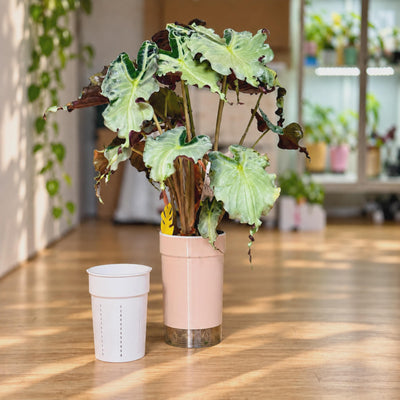
A lift-out insert makes that maintenance easier. My self-watering pots with visible reservoirs let you check the waterline and lift the inner pot for inspection and cleaning without dismantling the plant.
Common myths
- “Sprinkle cinnamon and the infestation is gone.” Cinnamon is not a reliable fungus-gnat control. Use moisture management and a treatment targeting larvae rather than adding more powder when flies return. [6]
- “Sticky traps solve the whole problem.” They catch adults and show activity; they don’t treat larvae in the medium. Pair them with action at the breeding source. [5]
- “One peroxide watering kills every stage.” A fizzy reaction is not proof that all eggs, larvae and pupae have been reached. Don’t treat the bubbling as a result test; track new adults and follow an established larval-control programme. [2] [3]
FAQ
Will bottom watering solve it?
It may help keep the surface drier, but only if the pot doesn’t remain constantly saturated. Check moisture in the medium and empty ordinary drainage saucers. Changing where water enters is not, by itself, a treatment for existing larvae. [1]
Are my plants in danger?
A few adults are usually more irritating than dangerous to an established plant. Heavy larval populations can damage fine roots, especially on young plants and cuttings. Prioritise those plants while treating the breeding sources. [1]
Should I add a thick sand layer?
Don’t rely on a top layer as your main control. Research has found sand and diatomaceous-earth barriers unreliable at preventing emergence or egg laying, and a covering can make moisture harder to judge. Keep the surface accessible for inspection and treatment. [3]
Ask a question
Tell us which medium you use, whether you have found larvae, and what treatment you have tried. Are they coming from one pot or the whole cabinet? Include how long you have treated and whether trap catches are falling. That makes it much easier to identify the missing step.
Sources
- RHS: Fungus gnats.
- University of California IPM: Fungus gnats.
- Kansas State University: Fungus gnat management.
- Koppert: Entonem, Steinernema feltiae application guidance.
- University of Minnesota Extension: Managing insects on indoor plants.
- University of California IPM: Debunking pest myths.
- University of Massachusetts Extension: Fungus gnats and shore flies.
 The Complete Guide to Acclimating Tissue-Culture
 Alocasia Corm Troubleshooting: Mould, Soft Spots and Slow Growth
Comments