


Square or Round Pots? Plan a Plant Shelf That Actually Works

TL;DR
Choose square pots for an orderly grid, then leave enough room to use it. Measure the outer covers, leaves and access space, not just the nursery pots. Round pots can work beautifully in mixed-size displays. For either shape, choose the growing size around the roots and keep watering, light and lifting practical.
Measure the whole setup
Start with the usable shelf width, depth and height. Exclude hinges, door handles, brackets and anything else that obstructs a pot or leaf. Then measure the widest outside part of the complete pot, including its cover, projecting rim or saucer.
A nominal 9 cm (3.5 in) growing pot does not automatically occupy only 9 cm on the shelf. A cover can add width; a saucer or watering tray can add more. That difference matters when you are planning the last pot in a row.
- Across the shelf: check outer width, rather than the planting opening alone.
- Front to back: include leaves leaning towards the door and space to lift rear pots.
- Above: allow for the dome, plant height, future growth and any grow-light clearance required by the light manufacturer.
- For handling: check whether your fingers can reach the rim and whether the insert can clear neighbouring leaves.
Before buying a whole row, cut paper templates. Use the actual outer footprint, put them on the shelf and try reaching the back. Paper is much easier to rearrange than twelve freshly watered Alocasia.
Where square pots help
Square outlines organise naturally into rows, especially when the covers have similar outside dimensions. They use the gaps between circular outlines and can make labels, water checks and cleaning feel more orderly.
But filling a gap is different from fitting another whole plant. If you replace a round pot with a square pot of the same outside width, the shelf may still hold the same number across. The square uses more of its bounding footprint; whether you gain another pot depends on the actual dimensions and layout.
A simple example: a 50 cm (19.7 in) shelf can hold four 12 cm (4.7 in) covers across, using 48 cm (18.9 in) before handling gaps. If the full cover measures 13 cm (5.1 in), four require 52 cm (20.5 in) and will not fit. Those figures apply to the outside widths of either shape.
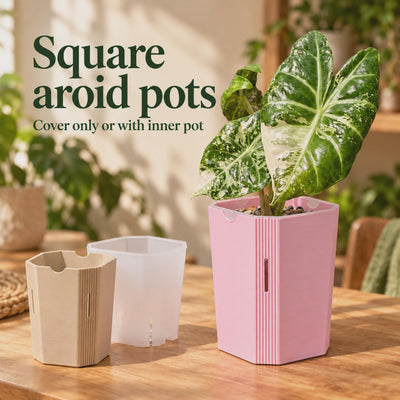
For a coordinated grid, my square aroid pot covers offer a slim outline, ventilation slots and finger cutouts for lifting the insert. Choose cover-only or the option with a matching clear inner pot, and check the size guide for your setup. [5]
Leave room for leaves
Pots fitting neatly does not mean the foliage fits neatly. An Alocasia leaf can span several container widths. A climbing Philodendron may need a pole; a Monstera can lean across the row beside it.
Arrange plants using their current canopy and likely next growth, not just how tidy the empty pots look. Try this:
- Place the largest leaves first. Check the door can close without pressing them against the glass.
- Place smaller plants around the available light. Do not hide them beneath a large leaf merely because the pot fits underneath.
- Test water access. Can you inspect each plant without moving the whole row?
- Reserve some flexibility. A vacant position is useful for the next leaf, a new arrival or temporarily separating a struggling plant.
Check light at leaf level, especially in the rear row. Shelf position, nearby foliage and distance from the light affect exposure. If plants stretch towards a brighter gap or lower foliage is increasingly shaded, adjust the arrangement rather than automatically raising the feed. [6]
Fit the roots first
Choose the inner growing space around the current root mass. A small-rooted plant in a very large volume of wet medium can be harder to water appropriately. [1] The outer cover gives you style and handling options without deciding how much growing medium the plant needs.
Two pots with the same top width can have very different depths and volumes. Compare the actual growing dimensions, particularly for a tall square insert and a shallower round one.
Do corners make better roots? Container shape can affect how roots develop. A study of vegetable plug trays found different effects between crops and growth stages; sweet corn showed no shape effect on root circling in that experiment. [2] That supports checking the whole growing arrangement, rather than treating four corners as a universal recipe for faster Alocasia growth.
When roots crowd the insert, consider the next appropriate size. For broader choices, explore pots in different shapes, colours and sizes. Keep the growing space suitable while choosing the display you enjoy.
Drainage and water access
Decide whether each pot is top-watered with drainage or part of an intentional self-watering reservoir system. A decorative cover around a nursery pot should not accidentally become a deep water bath.
- Top-watered nursery pot: let excess water drain and discard runoff collected in the cover or saucer. [4]
- Purpose-designed self-watering system: keep to its specified waterline and check moisture in the growing medium.
- Clear insert: lift it carefully for checks, without pulling on the plant's stems.
- Ventilated insert and cover: keep their openings clear and allow the intended space around them.
The medium needs air spaces as well as water. Container depth, particle size and compaction affect that balance. [3] Keep the mix structured and avoid packing it hard merely to stop a tall plant wobbling; arrange suitable support instead.
Square rows are easiest to maintain when inserts are independently accessible. A shelf you can water in five minutes is more useful than an immaculate grid that takes twenty minutes to dismantle.
When round pots fit better
Round pots are convenient when you already use compatible round inserts, want a softer display outline or group plants of different sizes. Mixed-height and mixed-size arrangements can suit a living room better than a uniform nursery grid.
You can also combine shapes. Use square covers for compact young plants, then give a large specimen its own round pot with room around the canopy. There is no need to replace every established plant to make the shelf coordinated.
Try repeating colours or finishes to link different shapes visually. If the existing growing pots work well, compatible covers can change the display without a repot. Check fit before ordering, and do not assume a round or square label alone describes every taper and rim.
Common myths
- “Square pots always fit 20% more plants.” The actual gain depends on outside dimensions and shelf layout. Compare complete footprints with templates; filling geometric gaps does not automatically fit another leaf canopy.
- “Square pots never develop circling roots.” Shape can influence roots, but crop and growth stage matter. Keep checking the root mass rather than assuming corners eliminate every root-space problem. [2]
- “Touching covers mean the cabinet is efficiently filled.” Check leaf light, lifting access and growth space too. A crowded canopy can be inconvenient even when the pots form a perfect grid.
- “A tight cover guarantees better airflow through the slots.” Leave the space the system is designed to use. Also maintain air spaces in the growing medium. [3]
FAQ
Should I replace all my round pots?
No need if they fit your roots and routine. Test a few square setups where rows are useful, then compare handling and usable space before replacing an entire shelf.
Can square pots work with PON?
Yes, with an appropriate water arrangement and growing size. Shape alone does not decide whether a pot is self-watering. Check the insert, reservoir or drainage setup and the actual medium.
How closely should I place the pots?
Close enough to use the shelf well, but with enough access to lift inserts and enough canopy space for light and growth. Test it with the actual plants; there is no universal gap that suits every Alocasia or Monstera.
Ask a question
Planning a shelf? Share its usable width and depth, your complete pot widths and the largest plants you want to fit. Mention whether you need domes, poles or rear-row access. A simple sketch or those measurements makes the layout much easier to work out.
Sources
- RHS: Overpotting.
- Chen, Ito and Shinohara (2002): Effects of cell shape on vegetable plug transplants.
- Iowa State University: Potting media, air spaces and container depth.
- University of Maryland: Watering indoor plants and discarding runoff.
- Variegata Nordica: Square aroid pot cover, options and care.
- University of Minnesota: Lighting for indoor plants.
 How to Use a Plant Drip Tray Without Leaving Roots Sitting in Water
 Clear Pot Covers: Less Algae, Easy Water Checks and a Cleaner Look
 Tiered Plant Trays for IKEA Cabinets: Light for Every Plant
Comments