


Choosing Pots for Alocasia, Monstera and Philodendron
TL;DR
Choose the growing space around the roots, then choose how you want to water. For Alocasia, Monstera and Philodendron, look for a suitable insert, accessible drainage or reservoir, and a medium that holds moisture while leaving air spaces. A removable inner pot and visible waterline make checks easier. Finish, shape and colour can then follow your home and collection.
Start with the roots
Big leaves are not a pot-size measurement. A young Monstera can have impressive foliage and a relatively small root system; a recently rescued Alocasia may need less growing space than before.
Gently lift the plant from its current growing pot when you are ready to inspect or repot. Look for:
- A crowded root mass: roots filling much of the pot, circling densely or displacing the medium suggest more space may help.
- Plenty of unused medium: hold the size steady rather than moving automatically into a larger pot.
- Recent root loss: fit the remaining healthy roots instead of buying for the plant’s former size. [1] [2]
Measure the root mass and compare it with the inner growing dimensions, not the decorative outer width. For a small, actively growing aroid, a modest increase of roughly 2–4 cm (3/4–1 1/2 in) in growing-pot diameter is a useful starting choice; use less after root loss. Check depth too, so long roots fit without being forced into a tight knot.
Buying the “forever pot” for a tiny plant? Let it grow into larger pots in stages. You can still give it a beautiful home now.
Choose your watering style
Top watering with a draining insert
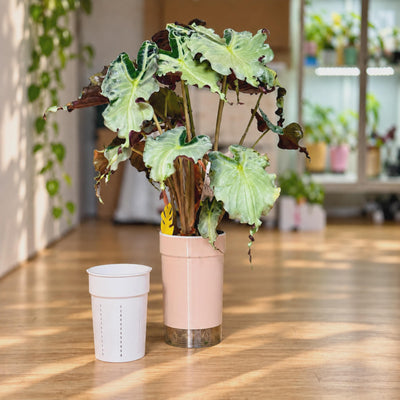
Water the medium thoroughly when the plant needs it, let excess drain and empty ordinary saucers or decorative covers. A draining nursery or slotted inner pot inside a cover keeps the roots accessible while letting you choose the outside appearance. [2] [4]
This suits you if you like lifting the pot to judge its weight and checking moisture before each watering. Make sure you can remove the insert once foliage and roots have grown.
A wick-based self-watering setup
A wick draws water from a separate reservoir into the medium. This can make moisture more consistent between your checks and reduce repeated near-dry periods. Choose a setup with a clear refill limit, a fitted insert and easy access to the reservoir.
The important distinction is stored water below the growing zone versus filling the growing zone with water. Keep the reservoir at the intended level, with the wick correctly positioned and in contact with the medium. Different reservoir designs have different startup routines; a commercial system with a growing-in period is not identical to a cotton-wick pot. [6]
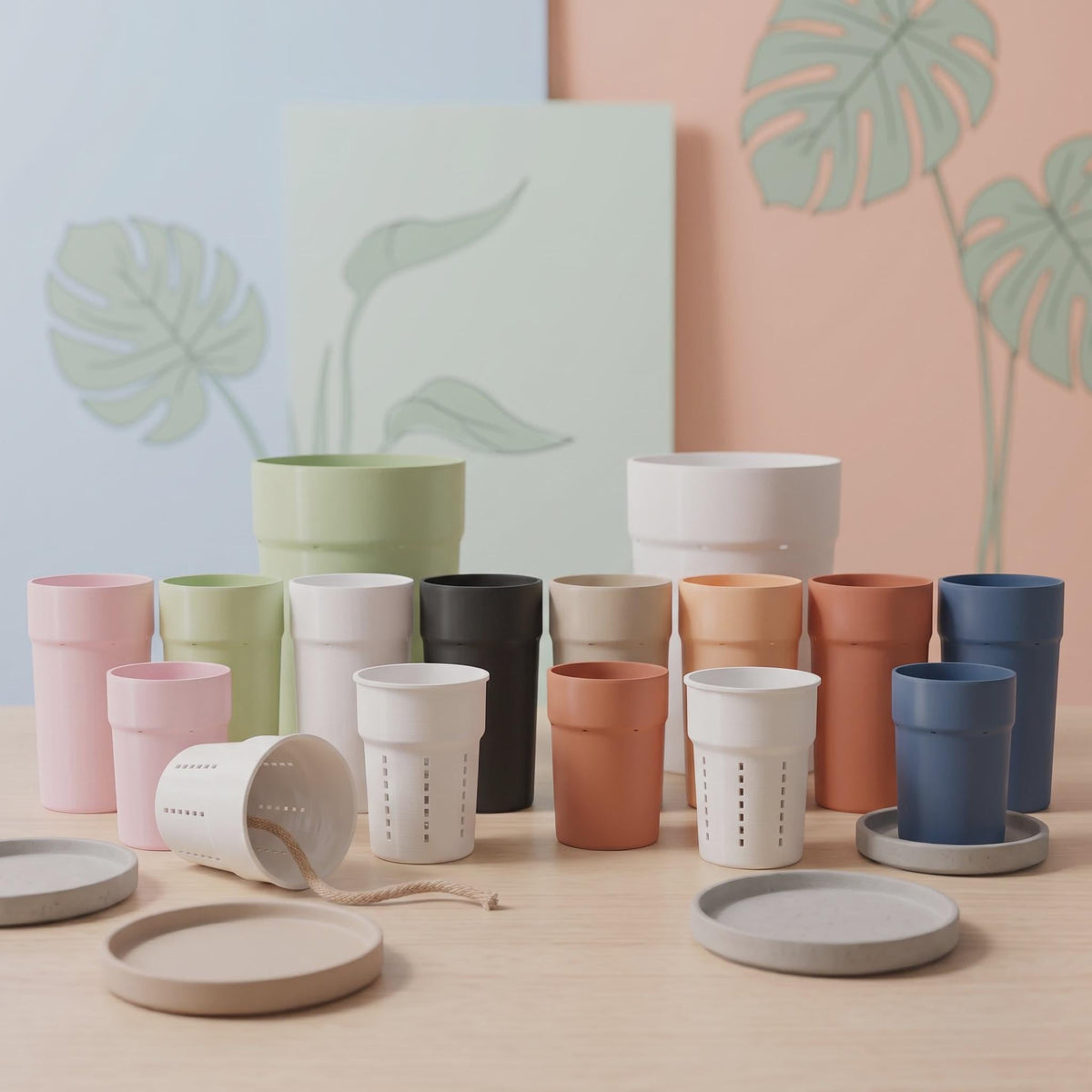
For my signature self-watering pot, the kit includes the fitted inner pot and cotton wick. Water from above and stop before the visible reservoir level reaches the coloured section. The removable insert makes root checks and reservoir cleaning straightforward.
Match the medium
Roots need both moisture and oxygen. In potting media, oxygen reaches them through the air-filled spaces between particles. Perlite and appropriately sized bark can help maintain those spaces; tightly packed fine material holds a different balance of water and air. [3]
- Small roots: use a mix with enough finer material to contact them. Huge bark chunks alone can leave little contact around a baby plant.
- A wick system: the medium must take up moisture from the wick. Check the area around the roots, not just whether the reservoir contains water.
- A bright, warm room: a very coarse mix may need water sooner.
- A dim winter room or humid cabinet: drying can be slower, so check before refilling on the same schedule you used in summer.
In practice, lift, inspect and adjust. If the root zone stays heavily wet while the plant is growing slowly, review the waterline, mix and light. If it dries repeatedly despite a filled reservoir, check wick contact and the medium’s ability to carry moisture upward.
Drainage and ventilation
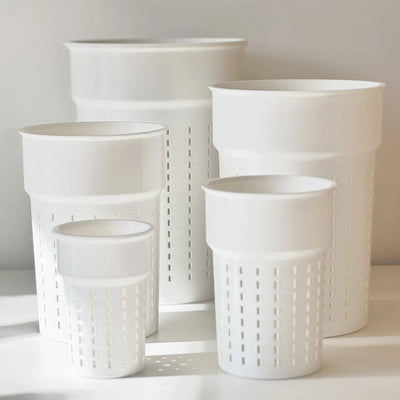
Look at the actual openings. Can excess water leave the inner pot? Can you see and clean the reservoir? Does the insert sit securely above it? Are side slots exposed rather than pressed tightly against a cover?
Slotted inserts and side vents provide additional access around the root zone. Pair them with a structured medium and keep openings clear. Waterlogged or compacted medium can exclude air even when the pot itself has holes. [3] [4]
If you use a moss pole, check its support before repotting. The plant and pole should be stable without an unnecessarily large volume of wet medium. Where needed, a heavier outer cover or separate pole support can add stability while preserving the right growing-pot size.
Materials and finishes
- Plastic: lightweight, easy to handle and slower to lose moisture through its walls than unglazed terracotta. Useful when you want to avoid repeated rapid drying.
- Unglazed terracotta: loses moisture through its porous walls, so check it more frequently in a warm or dry room.
- Glazed ceramic: often retains moisture more like other nonporous containers. Check whether it is a growing pot with drainage or a decorative cover. [2]
Clear reservoir or opaque finish? A visible reservoir makes a quick water-level check convenient. A clear growing insert serves a different purpose: it shows roots and moisture along the wall. With an opaque setup, lift the insert when checking. Choose the level of visibility that suits your routine.
Explore my assortment of shapes, colours and sizes once you know the required growing space. If you already have a compatible outer planter, extra fitted inner pots let you prepare another plant or swap inserts conveniently.
Your final checklist
Before buying, answer these five questions:
- Fit: does the inner growing space suit the current roots?
- Water: where does excess water go, and how do you check its level?
- Access: can you lift the insert and clean the outer pot?
- Compatibility: does the medium suit top watering or the intended wick system?
- Contents: are the insert and wick included, or are you buying an outer cover only?
After repotting, keep the plant in familiar light initially and check moisture more often while learning the new setup. Don’t add extra water simply because the plant looks slightly unsettled after the move. [2]
Common myths
- “A much bigger pot makes the plant grow faster.” Extra space helps when roots need it; a small or slow-growing root system in a large volume of damp medium can be harder to water appropriately. Size for the roots, not the growth you hope for next year. [1]
- “Plastic pots suffocate roots.” Material alone does not decide the root environment. Plastic retains moisture differently from terracotta, so match the watering routine and medium to it. Focus on air spaces, drainage and access. [2] [3]
- “Gravel turns a pot without holes into a draining pot.” Water still has no exit. Use a removable growing insert or a purpose-designed reservoir system. Research shows that layers can change water retention in pots with drainage, but that does not make every gravel arrangement equivalent or create an outlet in a sealed vessel. [4] [5]
FAQ
Can my aroid stay in its nursery pot?
Yes, while the roots have suitable space and the medium works for your conditions. Upgrade when you need more growing room or want easier reservoir watering, inspection or handling. A repot should solve a practical need. [1] [2]
Should I choose round or square?
Compare the inner dimensions and usable root space first. Square pots can organise a shelf neatly; round pots may suit your furniture or existing inserts. Check fit and access rather than assuming one outline is always better for roots.
Are roots growing through slots a problem?
Inspect their condition and how easily the insert lifts. A few firm roots outside a slot do not automatically mean urgent repotting. If the root mass is becoming trapped or the growing space is crowded, plan the next size change rather than pulling the insert free by force. [2]
Ask a question
Which plant are you choosing for? Share its current growing-pot size, the amount of roots, your medium and whether you prefer a reservoir. Is it in a cabinet or a normal room? Those details make a pot recommendation much more useful than a photo of the leaves alone.
Sources
- RHS: Overpotting.
- University of Maryland: Potting and repotting indoor plants.
- Iowa State University: Potting media, components and handling.
- RHS: Growing plants in containers.
- Rowe, 2025: Effect of drainage layers on container water retention, PLOS ONE.
- LECHUZA: Classic and stick-based reservoir systems.
 Using a Tissue-Culture Pot: Setup, Moisture and Dome Ventilation
 Monstera and Philodendron Aerial Roots: Guide, Leave or Trim?
 Repotting a Moss-Pole Plant into a Self-Watering Pot
Comments