


Salt Buildup in Self-Watering Pots: How to Flush and Reset

TL;DR
Lift the inner pot, flush to waste and replace the old reservoir contents. White crust can come from hard-water minerals or fertiliser. Check your feeding history before blaming the pot. Rinse accumulated salts out through the drainage openings, clean the empty reservoir and restart with a measured nutrient routine. This is useful for Alocasia, Monstera, Philodendron and other plants in wick or reservoir systems.
Recognising buildup
Look for a hard or crystalline white coating on the medium, wick, pot rim or waterline. It may come from minerals in your water, fertiliser, or both. Soft, fuzzy growth is different and should be inspected rather than automatically treated as a mineral crust. [2]
High dissolved-salt levels can make it harder for roots to take up water. Possible symptoms include brown tips or margins, reduced growth and wilting even while the medium is moist. Those symptoms also have other causes, so check:
- Feeding: what product, how much per litre or gallon, and how often?
- Medium: does it already contain fertiliser?
- Water: hard tap water, softened water, rainwater or reverse-osmosis water?
- Roots: firm and functioning, or soft and deteriorating? [1]
Brown tips after a stronger feed? Pause before adding another supplement. “More food” is not the first answer to possible fertiliser damage.
Why salts accumulate
“Salts” here means dissolved mineral compounds, including many plant nutrients, not just table salt. Water evaporates and the plant takes up water and nutrients at different rates. The remaining solution changes over time; repeatedly topping it up does not restore the original balance. [3]
With bottom or wick watering, deposits can also accumulate towards the upper medium. A periodic top rinse gives soluble salts an exit route. That rinse needs to drain away, rather than collect in the reservoir and return through the wick. [2]
Flushing the pot
Have a sink or collection bowl ready, plus room-temperature water low in dissolved minerals where possible. Distilled or reverse-osmosis water can be useful for a reset, especially if hard water is contributing to the deposits. [2] [3]
- Remove the inner pot. Support the plant and medium; don’t lift by the stem or pull an established wick through the roots.
- Empty the reservoir. Set it aside. Place the inner pot where drainage can escape freely and cannot soak back in.
- Remove loose surface crust. Gently lift away accessible deposits without digging through fine roots. Don’t scrape an exposed stem.
- Pour fresh water slowly over the medium. Wet it evenly, allow drainage, then repeat. For established plants in freely draining potting mix, Maryland Extension recommends about three times the growing-pot volume for a mineral rinse. A 1-litre pot would use roughly 3 litres (about 3 US quarts), applied in stages. This means inner growing volume, not reservoir capacity. [2]
- Discard the runoff. Let the inner pot drain thoroughly before returning it to the cleaned outer pot.
If water pools on top or cannot leave through the openings, stop and check for a blockage or compacted medium. For a severely affected small pot, fresh medium may be a better reset than repeated rinsing. Don’t leave struggling roots immersed in a bowl of salty runoff. [1]
Using a mineral medium with added fertiliser? Check its instructions before making intensive flushing a routine. Original LECHUZA-PON contains slow-release fertiliser, while other products or variants may not. Read the bag you actually have. [5]
Cleaning and restarting
- Reservoir: hand-wash the empty outer pot with warm water and a soft brush, then rinse thoroughly. Clean removable parts away from the planted roots.
- Wick: check that it remains intact and properly positioned. Replace a deteriorated wick when you can do so without tearing roots.
- Refill: use the pot’s intended waterline. Avoid raising the reservoir until the growing medium is submerged.
- Feed: if excess feeding caused the problem, don’t immediately return to the same strong solution. Correct the dose and account for fertiliser already in the medium. [1] [5]
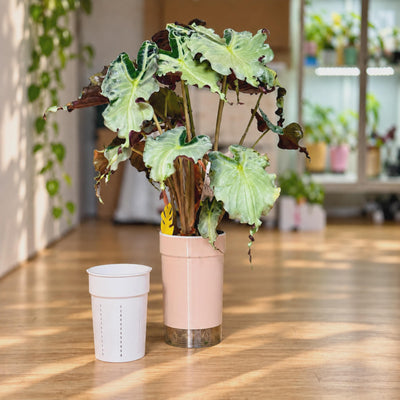
In my clear-reservoir self-watering pots, the fitted insert lifts out for rinsing and the visible waterline helps you refill accurately. Water from above and stop before the reservoir level reaches the coloured section, as shown in the product instructions.
Preventing a repeat
Separate top-ups from complete changes. In a hydroponic feeding programme, replacing water lost from an existing solution and mixing a fresh batch are different jobs. Follow the nutrient maker’s top-up guidance, and refresh the reservoir deliberately instead of indefinitely adding full-strength feed. [3]
Keep a simple note: reset date, nutrient dose and water source. Check for new crust when you refill. If buildup returns quickly, investigate the input water and feeding amount before increasing flushing frequency.
Prefer unsoftened water to water from a sodium-based domestic softener. Softening replaces calcium and magnesium with sodium; it is different from removing dissolved salts through reverse osmosis. A bypass tap can be useful if your home has a softener. [4]
For mineral-media plants, also check whether you are doubling up on slow-release granules and liquid feed. More than one nutrient source needs a coordinated feeding plan. [5]
Do you need an EC meter?
An EC meter measures electrical conductivity, an indication of the total dissolved-salt level. It can help if you maintain several semi-hydro plants and want to compare source water, freshly mixed feed and the reservoir later. Calibrate it and keep the units consistent. [3]
It does not identify which nutrient is high or low. Don’t copy a lettuce crop’s target value onto every Alocasia, or compare a reservoir reading with a soil-extraction threshold as if they were the same test. Use the nutrient supplier’s guidance for your growing system.
Common myths
- “Leaving tap water overnight removes the hardness.” Hardness comes from dissolved calcium and magnesium, not a gas that simply evaporates overnight. Standing water is not a dependable way to remove those minerals; check your water source if deposits keep returning. [6]
- “A good pH reading means the feed cannot be too strong.” pH describes acidity; EC indicates dissolved-salt concentration. A solution can have an acceptable pH and still be overly concentrated. [3]
- “Epsom salts are a harmless fix for any unhappy plant.” They add magnesium and sulfate, which are more salts. Use them for an identified need, not as a general rescue treatment on top of an already excessive feed. [7]
FAQ
Is every white deposit damaging?
No. A coating on an empty reservoir wall does not, by itself, reveal the salt concentration around the roots. Clean it, review your inputs and assess the plant. Investigate persistent deposits alongside deteriorating growth rather than assuming either harmlessness or disaster. [2]
Will flushing repair brown leaf tips?
Existing damaged tissue will remain damaged. Watch whether fresh leaves develop normally and whether the problem stops spreading after you correct the cause. [1]
Can I pour vinegar through the planted pot?
Don’t improvise an acid rinse to dissolve crust around roots. Controlled nutrient pH adjustment is different from pouring a cleaning mixture through a plant. Clean empty removable parts separately, using a method compatible with their material. [3]
Ask a question
Where is the crust: on the medium, wick, waterline or all three? Tell us your water source, medium, nutrient product and dose. Include whether you top up an existing reservoir or empty it before refilling. Those details help identify what is building up and how to change the routine.
Sources
- University of Maryland: Fertiliser toxicity and high soluble salts.
- University of Maryland: Mineral and fertiliser deposits.
- Oklahoma State University: Electrical conductivity and pH in hydroponics.
- Penn State University: Softened water and indoor plants.
- LECHUZA: Original PON ingredients and included fertiliser.
- US Geological Survey: Hardness of water.
- University of California IPM: Epsom salts and common garden myths.
 How to Use a Plant Drip Tray Without Leaving Roots Sitting in Water
 Using a Tissue-Culture Pot: Setup, Moisture and Dome Ventilation
 Clear Pot Covers: Less Algae, Easy Water Checks and a Cleaner Look
Comments