


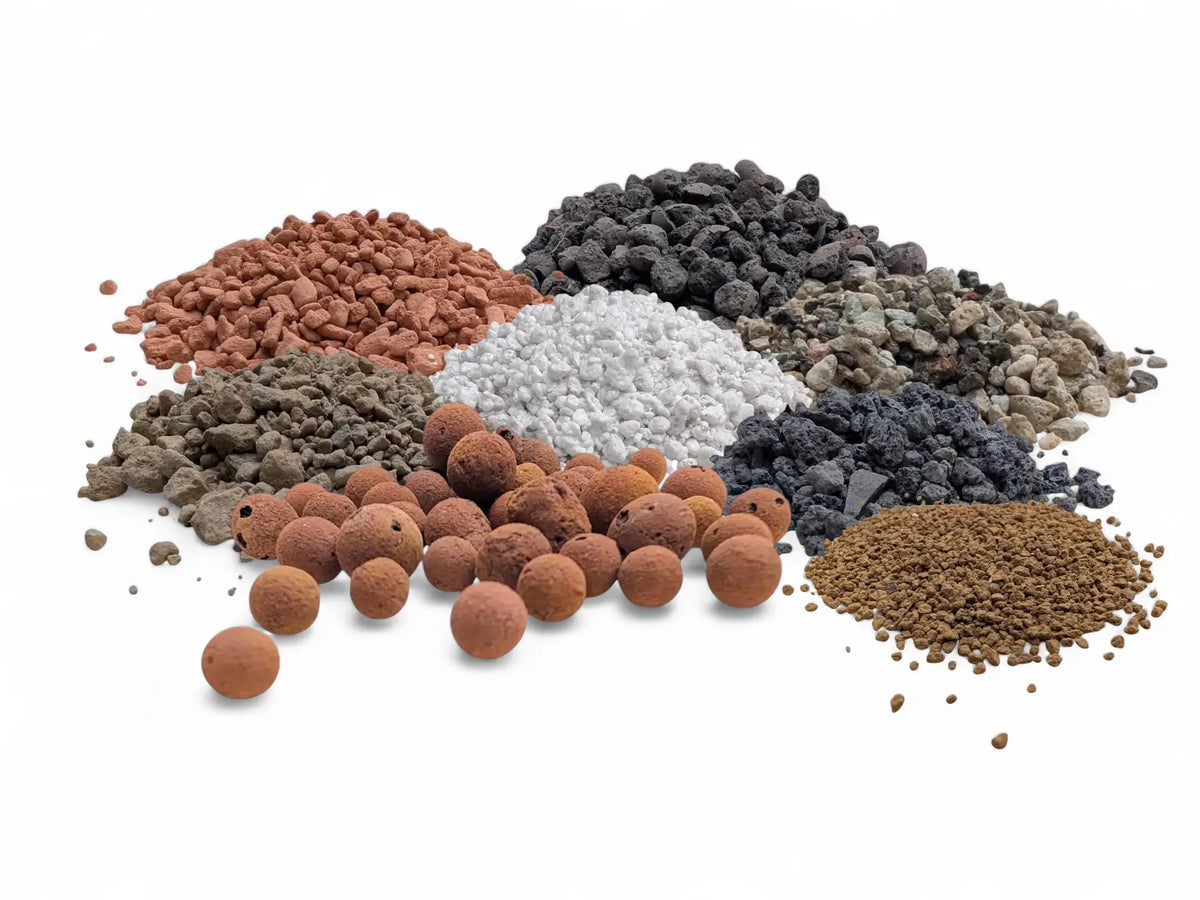
PON, Perlite or LECA: Choosing a Semi-Hydro Medium
TL;DR
Choose the medium you can keep appropriately moist and feed correctly in your actual pot. PON, perlite and LECA can all be used in suitable systems. Their particle sizes, weight and water behaviour differ, so copying someone's waterline without copying the whole setup is risky.
Understand semi-hydro
In hobby houseplant care, “semi-hydro” often means growing in a mineral medium with an accessible water reserve. The label does not identify one standard pot, wick, reservoir depth or nutrient routine.
The medium supports roots and helps distribute water; it is not automatically a complete food source. Hydroponic growing needs a suitable balance of water, oxygen and nutrients. [3] Check what your chosen bag already contains and how your pot supplies moisture.
Compare the options
| Medium | Useful features | Check before choosing |
|---|---|---|
| Original LECHUZA-PON | Dense mineral blend; small particles can provide useful contact around roots. | Read the exact product label for the nutrient charge and watering instructions. |
| Perlite | Lightweight porous particles; convenient in many rooting and potting setups. | Handle dust carefully; assess stability, particle grade and moisture in the assembled container. |
| LECA | Expanded clay aggregate; larger grades create substantial spaces between particles. | Check particle size against root size, initial preparation, water reach and feeding requirements. |
Original PON contains pumice, lava and zeolite and includes a slow-release nutrient charge; other products bearing similar descriptions may differ. [1] Perlite is used to maintain air-filled pores in potting media and can be dusty when dry. [2]
Fine roots in large gaps? Choose a suitable finer grade or another medium rather than relying on the plant to bridge dry air spaces immediately.
Choose for your routine
- Small rooting projects: consider root contact, easy inspection and whether the container stays stable. A medium familiar from your supplier's routine can simplify the first attempt.
- Tall plants: check planter stability as well as medium weight. A pole still needs a secure anchor.
- Wick-watered pots: test whether the medium receives water from the actual wick arrangement.
- Direct reservoir contact: check where the roots and medium sit relative to water. Do not borrow a waterline from a different geometry.
- A healthy established plant: weigh the benefit of changing against the extra transition and monitoring work.
The internet has declared a winner? Ask which pot, root system and watering method won with it. “Best medium” is missing half the question.
Test before planting
- Read the product instructions. Check preparation and any existing nutrient charge.
- Prepare it appropriately. Handle dusty material gently and follow rinsing or soaking guidance for the exact product. Avoid inhaling dry dust.
- Assemble a small test. Put the medium in the intended insert with its wick or water reserve.
- Check moisture at root height. Do not inspect only the bottom or assume dark particles mean the entire upper zone is wet.
- Trial one manageable plant. Record reservoir use and plant response before converting a collection.
A spare-pot moisture test tells you about water movement in that arrangement. Once planted, roots and conditions change water use, so continue checking.
Move roots gently
When changing from an organic mix to mineral substrate, remove loose old material carefully according to the transition routine. Do not scrub healthy roots until they are perfectly white. Support the plant at a suitable depth and avoid crushing roots between large particles.
Check frequently after the move for firmness, moisture where roots sit and progressive deterioration. A wet reservoir with dry upper roots calls for a water-delivery check, not simply a larger reservoir.
For a fuller transition, see moving Alocasia from soil to PON. Choose an appropriately sized planter from my self-watering pot collection, checking the medium and irrigation arrangement together.
Feed and maintain it
For an unfertilised mineral system, use a complete nutrient product intended for that growing method and follow its rate and mixing instructions. Ordinary fertiliser products are not interchangeable merely because their labels say “plant food”.
For pre-fertilised PON, account for its existing charge before adding more. Do not treat “up to” a stated duration as an exact expiry date for every plant and condition.
If crust appears or the plant declines, check feed concentration and water management. Excess soluble salts can cause root and leaf injury; flushing a suitable system involves letting water pass through and discarding the runoff, not returning it to the reservoir. [4]
Common myths
- “LECA makes root rot impossible.” Check water placement and root condition. A mineral medium does not remove the need for oxygen and suitable irrigation.
- “PON means no fertiliser decisions.” Read the exact bag and account for any nutrient charge.
- “Perlite is only for cuttings.” It can be used in different growing arrangements; stability and water supply determine whether yours is practical.
- “A dry top means refill.” Assess moisture where the active roots are.
FAQ
Can I mix mineral media?
You can, but the blend changes contact and water behaviour. Test a small arrangement and avoid assuming the original components' watering instructions still apply unchanged.
Must I convert every Alocasia to PON?
No. Keep a manageable healthy setup unless there is a useful reason to change. A trial on one plant is easier to learn from than changing everything.
Do I need pH and nutrient-strength meters?
They can help when using a defined hydroponic nutrient routine. Learn the product's targets and meter use rather than chasing a single universal number for every species and water source.
Ask a question
Tell us your plant, exact medium, particle grade, pot type and reservoir or wick arrangement. Are you choosing a first setup or troubleshooting an existing one? Include the fertiliser product if feeding is the concern.
 What Size Self-Watering Pot Does Your Plant Need?
 Japandi Plant Pots: Choose a Calm Display That Is Easy to Care For
Comments