


Variegated Alocasia Corms: Buying in the EU and Getting Started
TL;DR
Buy the corm you can verify, not just the mother plant you admire. Ask for current photos, its rooting stage, provenance and a clear delivery policy. EU dispatch can simplify the purchase, but it does not promise a particular leaf pattern. On arrival, inspect and label it, then give it gentle moisture, warmth and a covered propagation space.
Before buying
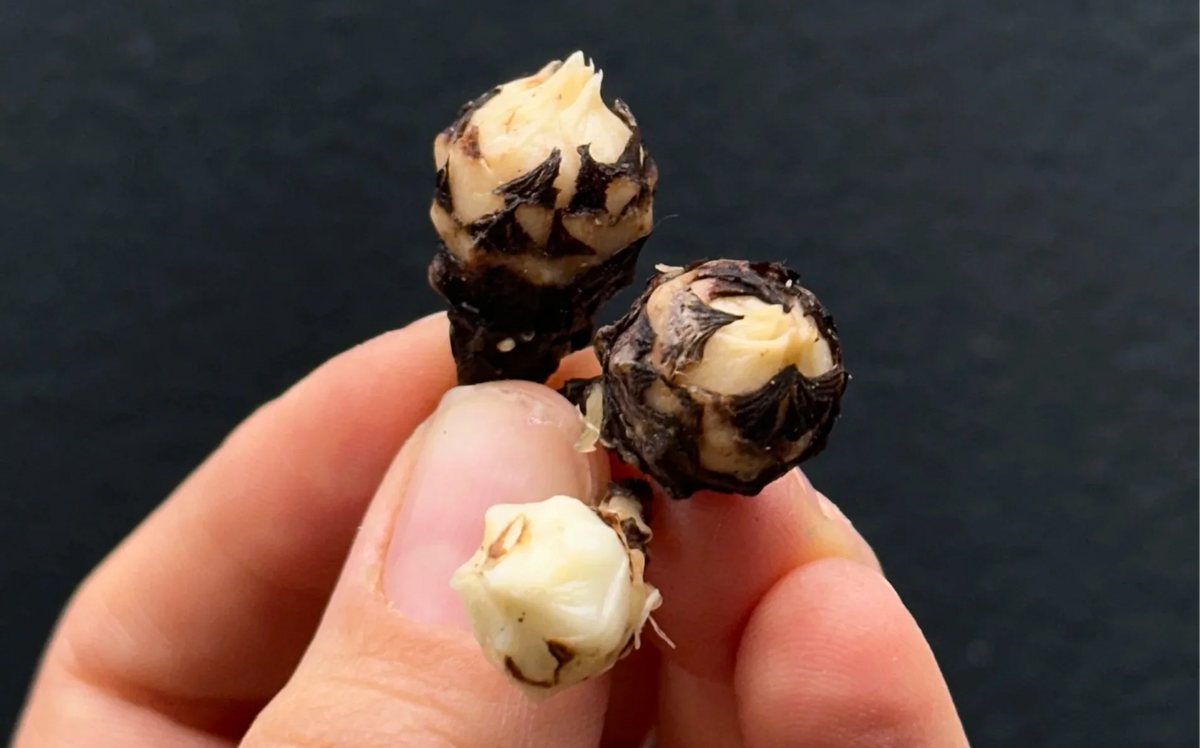
A corm sold by a collector may be a small dormant storage organ, already rooting, or sprouted with a leaf. Those are different purchases. A rooted plant with visible variegation gives you more information than an unrooted corm, usually at a different price.
Ask these questions before paying:
- What will I receive? A photo of the actual corm beside a ruler is more useful than a stock picture. Ask whether it has roots or a growing tip.
- Which plant produced it? Ask for the mother plant's name and current photos, and whether the corm can be traced to it.
- Where does it dispatch from? A European-looking storefront may still ship from outside the EU.
- How is it packed? Ask about keeping it secure, avoiding excessive wetness and protecting active roots.
- What happens if it arrives damaged? Read the claim window and required photographs before ordering.
Save the listing and seller's answers. For an expensive purchase, use a payment method with an appropriate dispute process and read its coverage. Be cautious about urgency tactics paired with no actual-corm photos.
“Rare” is not a care instruction. Ask what stage the plant is at and how it is currently growing. Those answers help much more than another adjective in the listing.
EU buying checks
Check both the seller's location and the physical dispatch country. Buying stock already in the EU generally avoids a new non-EU import leg for your parcel. That is a logistics advantage, not proof that a corm is healthier or genetically better.
Plant-health requirements still apply within the EU. Plant passports provide traceability for regulated material; the rules also cover distance sales to consumers. Ask a professional seller how they handle the applicable passport requirements for the material being supplied. A passport is not a guarantee of variegation or germination. [1] [2] [9]
If importing from outside the EU, check the requirements before ordering. Regulated plants and planting material may require a phytosanitary certificate and official checks. Great Britain is treated as a non-EU origin for these purposes; Northern Ireland has different arrangements. Consult the destination country's plant-health authority for the actual shipment, including any restrictions. [3]
Compare the total landed cost, rather than just the corm price: delivery, documentation, any applicable import charges and the practical consequences of a delay. For American readers, use the US import requirements instead; EU documentation is not a worldwide shipping permission.
Cold week ahead? Ask whether dispatch can be postponed. Do not treat a heat pack as permission to send a tropical plant through any temperature or delivery delay. A tracked service and a realistic receiving plan are worth arranging before checkout.
Variegation expectations
Variegation describes differently coloured areas of a plant. In many ornamental plants it involves genetically different tissues growing together, called a chimera. The pattern depends on how those tissues contribute to subsequent growth; it is not simply paint passed from one leaf to the next. [4]
Mother-plant photos establish provenance, not an exact forecast. A dramatic half-white leaf on the parent does not tell you what percentage of each future leaf a particular corm will produce. Ask the seller what is demonstrated and what is only expected.
- Dormant corm: you can inspect condition and provenance, but not its future leaf pattern.
- Sprouted corm: the first leaf provides more information, though the plant is still developing.
- Established plant: several leaves show a pattern over time and reduce the amount you have to infer from the parent.
Green tissue contains chlorophyll, the pigment involved in capturing light for photosynthesis. Very pale growth has less capacity to support itself, so the whitest plant is not automatically the easiest one to grow. [5] Choose the balance you enjoy and can support, rather than assuming a larger price tag means stronger growth.
Arrival inspection
- Photograph before unpacking. Include the packaging, label and any visible damage. Keep these while checking the purchase.
- Inspect gently. A sound corm should feel firm rather than collapsing. Loose dry outer material differs from a soft, wet interior. Do not repeatedly squeeze a tiny growing tip.
- Look at roots, if present. Firm roots and active tips are useful signs. Photograph soft or collapsing areas and ask the seller for advice before cutting indiscriminately.
- Label and separate it. Keep the new arrival in its own clean setup while watching its condition. Inspect any existing leaves for pests before placing it among your collection.
Do not peel all the outer covering merely to see whether the inside looks nicer. Corms are storage structures with buds and reserves; unnecessary injury can damage the tissue you want to grow. [6]
Starting germination
For a firm, dormant corm, choose one manageable method and stick with it initially. Moist horticultural perlite in a small covered container is a straightforward option: pre-moisten it, drain excess water, and settle the corm with its growing point upward and top exposed. The base needs moisture contact; the whole corm need not be submerged.
If orientation is unclear, ask the seller for a marked photo instead of guessing and repeatedly moving it. Use bright indirect light and stable warmth. Around 22–26°C (72–79°F) is a practical home starting range, not a guaranteed germination formula. Keep the cup out of direct sun and away from a cold window. Alocasia are warmth-loving indoor plants. [7]
Check through the container where possible. If the medium is still moist, skip watering. Briefly open it for inspection and remove decaying debris. Propagation media need moisture alongside air spaces; saturated, compressed material makes that balance harder. [8]
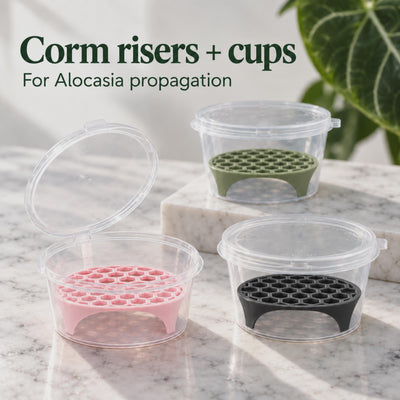
For a tidy individual setup, corm risers with clear cups keep the corm positioned with space below for developing roots. Set the water contact according to the kit instructions and keep the growing point exposed. Labels and a clear view make it easier to follow each corm without disturbing it.
Check weekly progress, not hourly suspense. Take a photo from the same angle. A firm corm with no visible change deserves stable conditions, not a different medium every weekend. If it becomes soft or deterioration spreads, separate it and inspect more closely.
Roots and first leaves
Once roots and a leaf are developing, continue the stable routine. Do not suddenly remove the cover because the first leaf has unfurled. Increase ventilation in small steps and back off if leaves wilt. Move to a bigger pot when the roots need room, rather than on the first day you see a root tip.
An adjustable humidity cup combines a small growing pot, reservoir and cover for this stage. For detailed method choices and troubleshooting, continue to the Alocasia corm propagation guide.
Do not chase colour by moving a baby plant into harsh sunlight. Give it suitable light for growth and assess successive leaves. An all-white first leaf or a green first leaf is a reason to watch the next growth carefully, not automatically cut the plant back.
Common myths
- “A half-moon mother guarantees half-moon babies.” A parent photo cannot guarantee the exact pattern of future leaves. Buy on documented provenance and observed growth, with realistic expectations. [4]
- “More light will turn a genetically green plant variegated.” Good light supports growth; it does not reliably manufacture the missing variegated tissue. Do not burn a seedling trying to force white patches. [4] [5]
- “EU-grown means adapted to every European home.” Ask about the actual conditions: a warm humid cabinet and a dry winter flat are very different environments.
- “Peel every corm and keep it completely underwater.” Neither is a universal requirement. Preserve firm tissue, avoid damaging buds and give the base controlled moisture with the top exposed.
FAQ
Is a corm or a small plant better for a beginner?
A rooted plant with visible leaves lets you judge more of its condition and pattern. A dormant corm is a propagation project: rewarding if you enjoy watching development, but with more uncertainty at purchase.
Can I tell the variety from a bare corm?
Usually not reliably from its appearance alone. A named listing needs trustworthy provenance. Keep labels attached from arrival onwards, especially when germinating several similar-looking corms.
What if it has not sprouted after several weeks?
Check firmness, moisture contact and temperature. If it remains firm, maintain sensible stable conditions and ask the grower about its history. There is no universal expiry date based on the calendar alone.
Ask a question
Choosing between two listings or worried about an arrival? Tell us the variety, dispatch country, dormant or rooted stage and what the seller has actually shown. For germination questions, add medium and temperature. Never post payment details or your delivery address in the comments.
Sources
- European Commission: Plant health rules.
- European Commission: Trade in plants within the EU.
- European Commission: Plants imported from non-EU countries.
- RHS: Plant mutations and chimeras.
- RHS: Reversion.
- University of Florida: Corm anatomy.
- RHS: Growing Alocasia.
- RHS: Propagation techniques.
- European Commission: Plant-passport audit, including distance sales to consumers.

 The Puddle Method for Alocasia Corms: Rooting Without Rot
 How to Do the Puddle Method for Alocasia Corms
 The Complete Guide to Acclimating Tissue-Culture
Comments